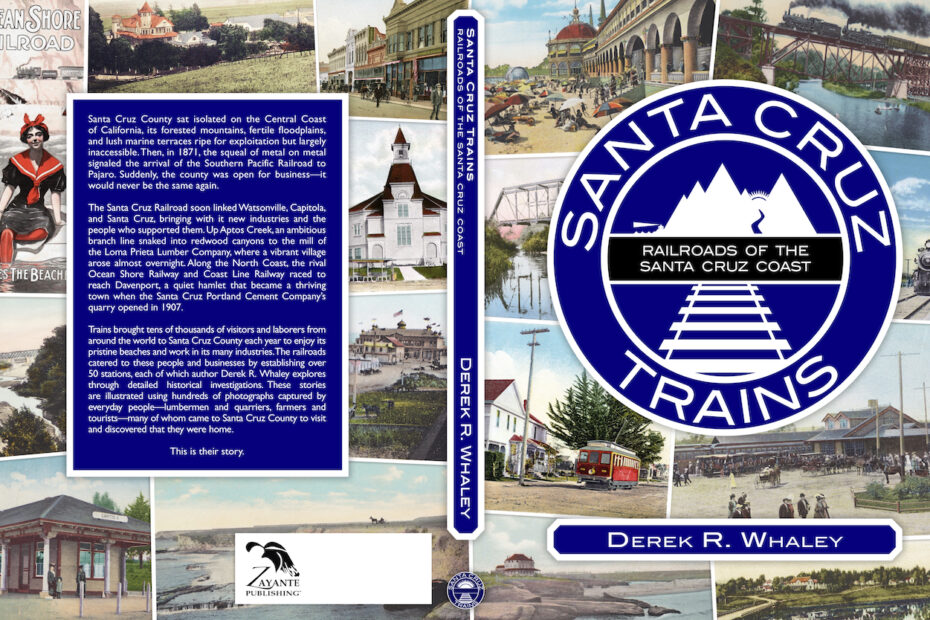
New book tells the history of over 50 railroad stations along the Santa Cruz Coast
Santa Cruz Trains: Railroads of the Santa Cruz Coast arrives November 1, 2026, marking 150 years since the county’s first rail link to the outside world
SANTA CRUZ, Calif., October 19, 2026 — Zayante Publishing will release Santa Cruz Trains: Railroads of the Santa Cruz Coast, a 352-page illustrated history by local historian Derek R. Whaley, on November 1, 2026. The book traces the rise and fall of more than fifty railroad stations that once stitched together the communities of the Monterey Bay and the Santa Cruz North Coast, from Pajaro and Watsonville to Capitola, Santa Cruz, Davenport, and the vanished lumber village of Loma Prieta.
The book arrives just over 150 years after the completion of the Santa Cruz Railroad in May 1876, the county’s first connection to the outside world and the event that ended its isolation on California’s Central Coast.
“Santa Cruz County sat isolated on the Central Coast of California, its forested mountains, fertile floodplains, and lush marine terraces ripe for exploitation but largely inaccessible,” Whaley writes. “Then, in 1871, the squeal of metal on metal signaled the arrival of the Southern Pacific Railroad to Pajaro. Suddenly, the county was open for business—it would never be the same again.”
A history told through the places people lived
Rather than a conventional account of locomotives and corporate mergers, Railroads of the Santa Cruz Coast is organized around the stations themselves and the towns, resorts, and industries that grew up around them. More than fifty in-depth station histories are gathered into four parts covering the Southern Pacific Railroad’s Pajaro Branch from south of Gilroy to Pajaro, the Santa Cruz Branch from Pajaro to Santa Cruz, the Loma Prieta Branch along Aptos Creek, and the Davenport Branch along the North Coast, together with the Southern Division of the Ocean Shore Railway, which paralleled the Davenport Branch and continued to Swanton.
The book explores the rise of summer resorts at Manresa Beach, New Brighton, Capitola, and the Santa Cruz Beach. It ventures into today’s Forest of Nisene Marks State Park, where the Loma Prieta Lumber Company spent three decades harvesting old growth redwoods to build cities from San Francisco to Honolulu. And it paces the Ocean Shore Railway and the Coast Line Railway in their race to reach Davenport and the Santa Cruz Portland Cement Company’s massive refinery. It also carries the story of the Santa Cruz Branch Rail Line to the present day.
The volume is illustrated with more than 250 photographs drawn from over 50 institutional and private collections, including the Santa Cruz Museum of Art & History, the Aptos History Museum, the Capitola Historical Museum, the Gilroy Museum, and the Pajaro Valley Historical Association. Many images are published here for the first time. Supporting material includes a timeline of events, a station name summary, a station location gazetteer, full citations, a bibliography, and a detailed index.
The book is a companion to Whaley’s first volume, Santa Cruz Trains: Railroads of the Santa Cruz Mountains (2015), and completes the coverage of railroad stations across Santa Cruz County and the surrounding region, touching on southern Santa Clara County, northwestern San Benito County, and northern Monterey County.
About the author
Derek R. Whaley was raised in Felton, California. He holds a PhD in History from the University of Canterbury, New Zealand, and works in Heritage Collections at Auckland Council Libraries. He began the research that became this book in 2012 with a blog post about an obscure flag stop called Kenville; that blog, www.SantaCruzTrains.com, has since become a standard reference for Central Coast rail history. He is the author of six books on Santa Cruz railroads and serves as editor-in-chief of Zayante Publishing, where he has edited and published works on Santa Cruz history by Ronald G. Powell and Ernest Otto.
The book is dedicated to the late Alverda Orlando (1930–2024), a longtime champion of North Coast history.
Book details
- Title: Santa Cruz Trains: Railroads of the Santa Cruz Coast
- Author: Derek R. Whaley
- Publisher: Zayante Publishing, Santa Cruz, California
- Publication date: November 1, 2026
- Format: Paperback, 352 pages, 8.5 x 11 in., illustrated with more than 250 photographs
- ISBN: 978-1-953609-10-6 (paperback)
- Price: $36.99 (paperback)
- Library of Congress Control Number: 2026925793
- Availability: Amazon.com beginning November 1, 2026; Bookshop Santa Cruz from mid-November 2026
For media
Derek R. Whaley is available for virtual interviews and talks. Review copies, high-resolution cover art, and sample interior photographs from the book are available on request.
Media contact: editor@zayantepublishing.com
Lining up at the platform…
Seeing Santa Cruz Trains: Railroads of the Santa Cruz Coast finally in print is nothing short of a miracle. I came up with the name and logo way back in October 2015! At that time, I intended for it to cover the entire Monterey Branch and the Coast Division mainline between Watsonville Junction and Castroville, as well as the Pajaro Valley Consolidated Railroad. That would have been a far larger and more daunting book, for sure. First, though, I needed to finish my doctoral thesis and that wouldn’t be done until October 2017. In November, the scope of the book had narrowed to the present range, although industrial lines were still included and the Santa Cruz Branch section was divided in two, with Aptos ending the first section and New Brighton beginning the second.
The first blog posts on the topics covered by this book came out in late 2014, before my first book had even released. However, I wasn’t thinking about writing a second book at that time, so the attention to detail was lacking. My first intentional research toward this book didn’t begin until late 2017, my first author diary on the topic was made on June 24, 2018, and the first chapter draft wasn’t begun until December 2018. I made good progress through the winter and spring of 2019 until April, when Stanley Stevens accidentally dropped Ronald G. Powell’s unpublished magnum opus in my lap and I promptly got distracted for the next four years working on that. I then continued the trend with other books that seemed more manageable than this one.
I finally resumed work on this much-delayed book in May 2025 and a full draft of the first section was done before Christmas. Much of the early part of 2026 was focused on writing and producing a format for the book that I was happy with. Principal writing of the entire book ended on August 8, 2026. For the rest of August, I edited heavily and formatted photographs and created maps. One significant moment came on August 22, when I decisively moved a large chunk of the book introduction to the opening of Part 1. Editing was completed on September 5 and the bibliography and citations were organized two days later. Each page was carefully formatted one-by-one throughout September, ending on October 9. A proof was ordered the next day. In the meantime, I prepared the index and made some finishing touches to photo captions. The book went to print on October 17.
I already include a detailed acknowledgements section in the book’s foreword, but I want to thank again all of the support and help I have had over the years. From random Facebook and Instagram comments, to in-person discussions and email exchanges, to websites created by passionate railfans, to the museum and archives staff just doing their jobs—thank you all. This is not the last book I plan to write on the topic—just check some of my other author diaries from the past few years!—but I feel this is the completion of something I began back in 2012 with my very first blog post. With Santa Cruz Trains: Railroads of the Santa Cruz Coast, the history of Santa Cruz County’s railroad stations is complete. Every official station has been examined in detail, and with that examination, entirely new stories have been revealed, about people, industries, places, and dreams. Santa Cruz Trains has always been about the history of how trains helped create and enhance Santa Cruz County. I have no intention of ending that pursuit now.
I hope everyone enjoys Santa Cruz Trains: Railroads of the Santa Cruz Coast. And stay tuned for news about the next journey. All aboard!